Multi-Structure Segmentation in CBCT Volumes: the ToothFairy2 Challenge
Abstract
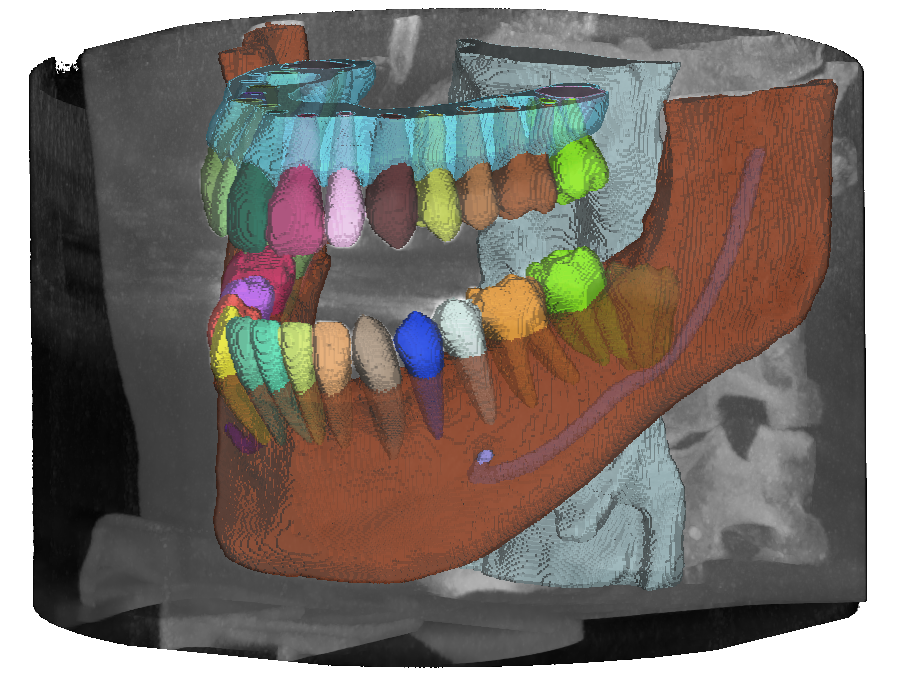
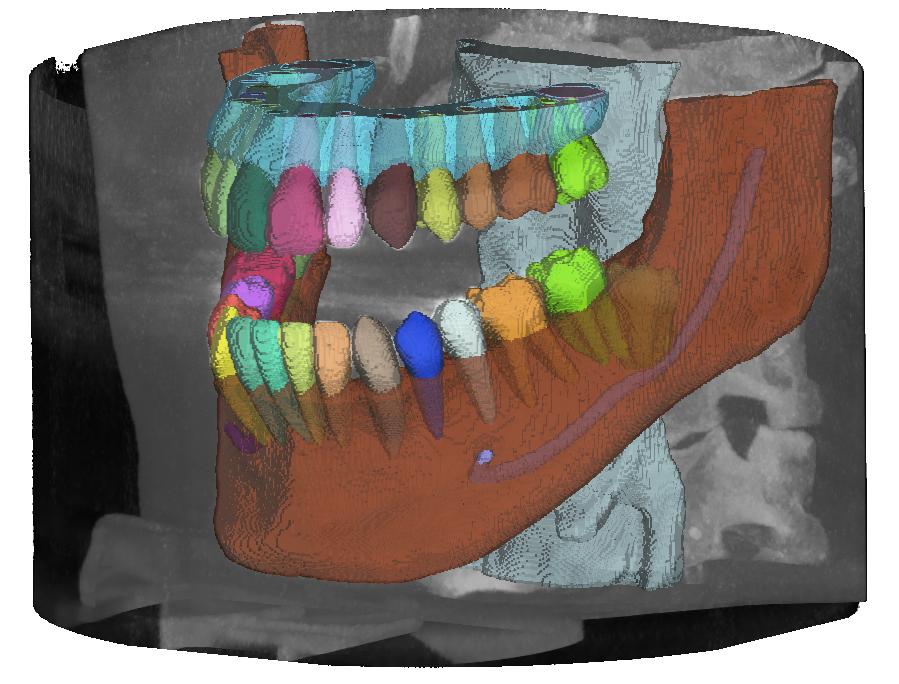
Cone-beam computed tomography (CBCT) is widely used for dento-maxillofacial diagnostics and treatment planning, and comprehensive multi-structure segmentation remains time-consuming, limiting large-scale, reproducible research. In this article, we present ToothFairy2, a MICCAI 2024 challenge on multi-structure segmentation in maxillofacial CBCT. The accompanying dataset comprises 530 CBCT volumes (480 public training, 50 hidden test) with expert 3D annotations of 42 classes, including maxilla, mandible, crowns, bridges, implants, inferior alveolar canals, maxillary sinuses, pharynx, and teeth labeled according to the International Tooth Numbering System (FDI). 26 international teams participated in ToothFairy2, and their methods were run and evaluated for voxel-wise multi-class segmentation using a standardized protocol. This report extends the evaluation of teeth to also investigate the current capabilities of tooth detection and FDI numbering. Furthermore, ranking stability was analyzed to assess the robustness of the final challenge outcome.
Overall, challenge participants achieved consistently high performance for large, high-contrast structures such as jawbones, pharynx, and most teeth, while maxillary sinuses, dental restorations, and fine structures remain challenging due to class imbalance and metal artifacts. Analysis of tooth-related metrics further revealed that assigning correct FDI numbers was more challenging than delineating individual teeth. By releasing CBCT data, 3D annotations, baseline models, and evaluation code, ToothFairy2 establishes a long-term benchmark to drive the development of automated methods for robust, clinically meaningful multi-structure segmentation in maxillofacial CBCT.
Links
Paper: DOI and IRIS record.
Dataset: ToothFairy2 on Ditto.
Code and evaluation: AImageLab ToothFairy repository.
The benchmark supports reproducible comparison of 3D segmentation methods for clinically meaningful CBCT structures. It also highlights limits of current methods: tooth identity assignment, maxillary structures, dental restorations, and small canals remain harder than large bony anatomy.
← Back to projects